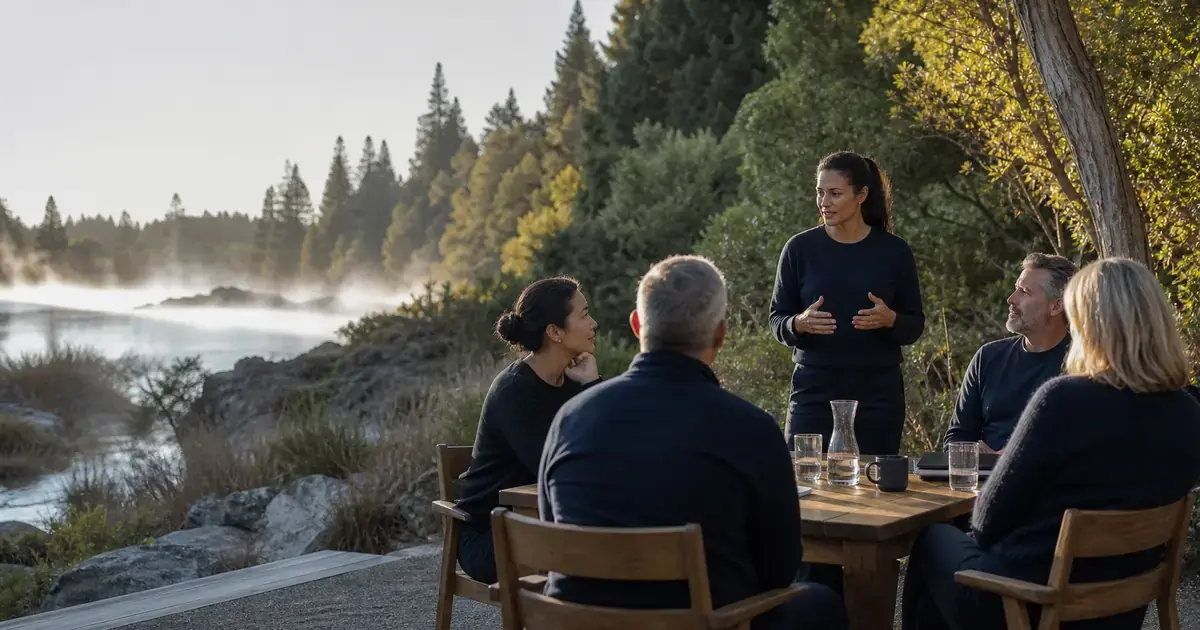
Executive Team Offsite Facilitator Rotorua: Unique New Zealand Experiences
Rotorua can be a strong setting for an executive team offsite when the facilitator and the experience do different jobs. Choose the person who can hold the real leadership conversation first. Then choose one local experience, such as a waka, geothermal, cultural or wellness activity, that helps the team do the work.
I compiled this guide to make it easier to plan an executive team offsite in Rotorua that has a clear purpose. In full transparency, I also provide executive team offsite facilitation, so I have kept my own work outside the verified provider comparison. You can read more about my background here.
Who this is for and how to choose
This page is for a chief executive, founder, board chair or senior leadership team deciding whether Rotorua is the right place for a serious offsite. It is especially useful when the group wants more than a meeting room and more than a generic team activity.
Start with the decision the room needs to make. The facilitator should be able to hold that conversation, surface disagreement and turn the conclusion into ownership. The local experience should then reinforce the purpose, not compete with it.
Rotorua has a useful range of settings for this. The official Rotorua business-events team describes geothermal landscapes, lakes, forests, Māori culture, adventure, spa and wellness options, and offers impartial help with venues, activities, transport and event services. Read the RotoruaNZ team-building and incentive guide before assuming the most memorable activity is the most useful one.
The Rotorua shortlist at a glance
The providers below are not identical. Some explicitly list team facilitation. Others are leadership, culture or team-development providers whose public evidence supports a useful part of an offsite. Confirm current availability, scope and neutrality before booking.
Canning is suitable for leadership team coaching, culture work and team facilitation. It works with business leaders across Rotorua and the Bay of Plenty. Read Canning.
Oxygen8 Bay of Plenty is suitable for leadership coaching, mentoring and follow-through. It supports organisations across Rotorua and the wider region, with face-to-face and online sessions. Read Oxygen8 Bay of Plenty.
Hum Consulting, including Mat Kearney, is suitable for leadership development, change and organisational work. Hum works in Aotearoa, and Mat Kearney is named as a facilitator for a current Rotorua leadership programme. Read Hum Consulting.
The Team Building Company is suitable for tailored team development, leadership training and facilitation. It is a New Zealand provider with a Rotorua leadership-team testimonial. Read The Team Building Company.
Facilitator and leadership-support options
Canning, Rotorua and the Bay of Plenty
Canning is a strong fit when the offsite needs leadership team coaching, culture work or a facilitated conversation rather than an activity by itself. Its business-coaching page says it partners with business leaders across Rotorua and the Bay of Plenty, and it lists Leadership Team Coaching as well as Workshops and Keynotes that include team facilitation.
The page describes a five-step approach to leadership team coaching and names concerns such as poor communication, low confidence, fear of failure and siloed thinking. Ask Canning whether the person leading the day will be neutral enough to facilitate a difficult executive conversation, or whether the engagement is better shaped as coaching and follow-through.
Oxygen8 Bay of Plenty
Oxygen8 is a useful option when the offsite needs to connect to business improvement after the event. Its Bay of Plenty page says the team works with organisations across Tauranga, Rotorua and the wider region, offering coaching, mentoring and advisory support for leadership capability and resilient teams.
The same page says sessions can be face-to-face or online and that engagements are shaped around the organisation's goals. That makes Oxygen8 more clearly a leadership advisory and coaching option than a stand-alone offsite facilitator. Confirm whether the proposed work includes independent facilitation, leadership-team coaching, or post-offsite support.
Hum Consulting, Mat Kearney
Hum Consulting is a fit when the offsite is tied to leadership development, organisational change, people strategy or a broader transformation. Hum's own site describes work across Aotearoa and internationally, including organisational design, people and culture strategy, change management and leadership development.
There is also direct Rotorua evidence. Taituarā's current Leaders in Local Government programme in Rotorua names Mat Kearney as a facilitator and describes his experience in leadership development, change management, organisational design, and people and culture strategy. That does not prove that every Hum engagement is an executive offsite, so confirm the proposed format and outcomes.
The Team Building Company
The Team Building Company is a practical fit when the offsite needs a tailored team-development or leadership-training day. Its education services page describes workshops about workplace environments, communication, team dynamics, leadership training, conflict resolution and team building.
The same page includes a testimonial from the Deputy Principal of Rotorua Lakes High School describing Jenny as a facilitator who delivered a programme about courageous conversations, positive workplace environments and communication. Treat that as evidence of a Rotorua leadership-team facilitation example, not as proof of current availability or a particular executive-offsite format.
Unique New Zealand experience partners
The local experience should make the leadership work easier. It should create a shared point of reference, a calmer space for a different conversation, or a meaningful connection to place. It should not be a reward stapled onto the end of an otherwise ordinary meeting.
Te Puia is useful when you want a corporate setting connected to geothermal place and Māori culture. Read Te Puia functions and venues.
Aotearoa Waka Experience is useful when you want a facilitated cultural and team-building experience on the lakes or rivers. Read Aotearoa Waka Experience.
Polynesian Spa is useful when you want wellness, recovery and connection in a structured corporate format. Read Polynesian Spa corporate groups.
Hell's Gate is useful when you want a physical geothermal experience with bespoke group options. Read Hell's Gate groups.
Keswick Christian Camp is useful when you want a practical venue with meeting rooms and activity options. Read Keswick business groups.
How to choose the right Rotorua experience
Choose geothermal and cultural context when the team needs a change of frame
Te Puia offers corporate event facilities, meeting rooms, on-site catering, AV and parking in a geothermal setting. Its venue page also describes customised programmes and spaces connected to the story and traditions of the place.
This can suit a team that needs to step outside its normal assumptions, but cultural content must be approached with respect. Ask the provider how the experience is framed, what participation involves and what should not be treated as a corporate exercise. Read Te Puia's corporate venue information before making a decision.
Choose a waka experience when connection and communication are the work
Aotearoa Waka Experience says it offers facilitated water and land activities, workshops, team building, communication and leadership programmes for corporations. It describes two 24-seat waka and a cultural experience on the Rotorua lakes and rivers.
This can give the team a shared experience that is more meaningful than a generic icebreaker. It is still not a substitute for facilitation. Agree beforehand on the leadership question the activity is meant to support, and give the team space to reflect on what it noticed without forcing a manufactured lesson. Read Aotearoa Waka Experience's corporate information.
Choose wellness when the team needs recovery before it can think clearly
Polynesian Spa describes a lakefront corporate retreat format with a Wellness and Events Room for up to 60 guests. Its example Reset Day combines wellness activities, hot-pool bathing, a Redwoods walk, a food and wellness workshop, refreshments and healthy catering.
This is a good fit when the team is carrying fatigue, when the work needs space and when a high-adrenaline activity would be counterproductive. It is less suitable if the core problem is an unresolved decision that nobody has been willing to name. Read Polynesian Spa's corporate groups page.
Choose a physical activity when the group genuinely wants a shared challenge
Hell's Gate offers bespoke group experiences that can focus on wellness, private tours, cuisine or Māori culture. Its corporate page names options including mud tug of war, a volcanic scavenger hunt, private mud spa use and geothermal steam hāngi.
Keswick offers a different activity-led format. Its Rotorua business-groups page describes conference rooms, tailored programmes, on-site archery and air-rifle shooting, sporting activities and custom catering. Both options need a clear accessibility, safety and participant-consent check before they are included.
Read Hell's Gate groups and Keswick business groups.
How to choose a facilitator and what to ask
Ask the facilitator to describe the decision the day is designed to support, the pre-work they need, how they will handle disagreement and what will still be used 30 days after the team returns. A polished agenda is not enough. You need to know how the work will move from conversation to ownership.
Ask the experience partner a different set of questions. Confirm the actual capacity, meeting-room setup, weather plan, transport, dietary needs, accessibility, privacy, cultural framing, timing and cancellation terms. If the provider offers a beautiful activity but cannot explain how it fits your purpose, keep looking.
The strongest design usually has a quiet decision block, one carefully chosen local experience and a short carry-forward session. The experience can change the quality of the conversation, but the facilitator still needs to connect the conversation to the work waiting on Monday morning.
A worked example: the decision, container and carry-forward test
Imagine a six-person executive team travelling to Rotorua because it keeps revisiting one strategic choice. The starting input is not a request for a fun day. It is one decision that needs a clear owner, a first action and a review point.
The first move is the decision. The team writes the choice in one sentence and names what will be different if it is resolved. The facilitator then tests whether the disagreement is about facts, priorities, risk, authority or trust. That distinction changes the right conversation.
The second move is the container. If the team needs calm and reflection, a wellness or private lodge format may fit. If the team needs a shared challenge and a stronger connection to place, a waka, geothermal or activity-led experience may fit. The local partner is chosen because it supports the work, not because it photographs well.
The third move is carry-forward. Before the team leaves, one person owns the first action, the team agrees when it will review progress and the facilitator records the question that must not be avoided when the group returns.
The result is a more honest test of success than a happy evaluation form. The offsite has worked when the decision is clearer, ownership is visible and the next conversation is easier to start. The limitation is that this is a planning example, not a named client case or a promised outcome.
Strongest counterargument and limitations
The strongest counterargument is that the team does not need Rotorua. It needs better leadership conversations, and a destination can become a costly distraction. That criticism is fair. A beautiful setting cannot repair an executive team that has not agreed what it is there to decide.
This is why the facilitator comes first. Rotorua is useful when its distance, cultural context, nature or wellness options create conditions the normal workplace cannot provide. If the team can already have the necessary conversation in its own meeting room, a local offsite may be the more honest choice.
The provider pages do not prove current availability, total scope, neutrality, accessibility for every participant or suitability for a private leadership conflict. Some approved options are adjacent leadership or team-development services rather than pages explicitly titled executive offsite facilitation. Confirm the exact offer in writing.
Māori culture should not be treated as a prop for corporate bonding. Follow each provider's own guidance, ask what participation means and give people a respectful way to opt out of anything that is not appropriate for them. Weather, health, mobility, dietary, privacy and travel needs may also change the right choice.
Your practical next action
Take ten minutes and write one sentence that begins, "By the end of this offsite, our executive team will have decided..." Then write the one behaviour or ownership change that must be visible within 30 days. Send those two sentences to any facilitator you are considering and ask them to respond with the format they would recommend.
Frequently asked questions
Do I need a facilitator based in Rotorua?
No. A provider can be based elsewhere if the current evidence supports delivery in Rotorua or a clear New Zealand-wide relationship. Ask for the exact travel, delivery and follow-through arrangements rather than assuming that a national provider is available for your date.
Should the experience happen before or after the strategy work?
It depends on the purpose. A short shared experience can help people arrive and connect, but the main activity is usually more useful after the team has done the decision work, when it can give the group a shared reference point rather than delay the difficult conversation.
How do I include Māori culture respectfully?
Start with the local provider's own guidance. Ask what the experience represents, who leads it, what participation involves and how the group should behave. Do not copy tikanga or turn cultural elements into a leadership metaphor without permission and proper context.
Is an adventure activity necessary for an executive offsite?
No. A facilitated conversation, a quiet setting or a wellness format may be more useful than a physical challenge. Choose the experience only when it supports the team's decision, connection or recovery needs.
What should happen after the team returns?
The team should have one clear owner, one next action and a review date. If the offsite produces a long document but nobody knows what will be different in the next meeting, the carry-forward work is incomplete.
Methodology, reviewer state and correction route
How this directory was compiled: I searched Rotorua and New Zealand results for executive team offsite facilitation, leadership-team support, corporate retreat experiences and relevant venues. I included providers only where a fetched own-domain page or a current primary event record showed a relevant service and a Rotorua relationship. I kept experience partners separate from facilitator options, and I have not included prices for named providers. This was last checked in August 2026.
Review status: NOT INDEPENDENTLY REVIEWED. This page was produced in a controlled live queue run after a fresh source check on 4 August 2026. If a provider, URL or description needs correction, use the team offsite enquiry page and identify the exact passage.
Sources
The public page 25 Executive Team Offsite Facilitators in New Zealand was used for the broad national comparison and duplicate check. The city-specific pages for Queenstown and Wellington were used to test whether a Rotorua page could have a distinct location purpose.
Provider evidence came from Canning, Oxygen8 Bay of Plenty, Hum Consulting, the Taituarā Rotorua leadership programme and The Team Building Company.
Destination and experience evidence came from RotoruaNZ, Te Puia, Aotearoa Waka Experience, Polynesian Spa, Hell's Gate and Keswick Christian Camp.
The internal planning links are supported by leadership retreat locations, planning a leadership retreat and the team offsite enquiry page.
Next Read
For the broader provider landscape, read executive team offsite facilitators in New Zealand. For the planning sequence, read planning a leadership retreat.
A practical offer
I help leaders turn an offsite into a clearer decision, a healthier conversation and a next step people can actually use. If you want help thinking through the fit, start with the team offsite enquiry page and share the decision your team needs to make.