How School Principals Can Use Working Genius to Build a Healthier Team
Last updated: July 2026
Working Genius helps school principals build a healthier team when it becomes a shared language for how work moves, not a label for who people are. Used well, it helps a leadership team notice where work is stalling, where energy is being drained, and where the principal is carrying too much alone.
As of July 2026, that matters because the pressure on school leaders is not abstract. Education Support's 2025 Teacher Wellbeing Index reports that 76 percent of education staff are stressed, 86 percent of senior leaders feel stressed, and 81 percent of senior leaders say they have too much to do and not enough time. RAND's 2022 State of the American Teacher and State of the American Principal work also found that teachers and principals reported worse wellbeing than other working adults, with staffing named as a top source of principal stress.
In Australian reporting on the 2024 principal wellbeing survey, 53 percent of principals surveyed signalled an intention to quit, with severe anxiety reported at 9 percent and severe depression at 7 percent. Earlier national reporting on the 2023 survey said 48.2 percent of principals had experienced violence and 53.9 percent had been threatened. Those figures are not used here to dramatise the job. They are a reminder that a healthier leadership team is not a soft side project.
I am a Certified Working Genius Facilitator, certified through Patrick Lencioni's Table Group, and the author of Step Up or Step Out, and what follows comes from real work with leadership teams, not just theory. The point is not that Working Genius magically fixes workload, staffing, behaviour, parental pressure or the complexity of school life. The point is more practical: if a leadership team can see how work actually moves, it can stop wasting energy in avoidable friction.
This guide is for principals who want to use Working Genius with wisdom. It will show what the model is, why the leadership team should go first, how to map the work before mapping the people, how to redesign meetings, how to reduce hidden load, how to avoid the common mistakes, and how to build a term-long rhythm that changes behaviour rather than adding another poster to the staffroom wall.
What does Working Genius mean for a school leadership team?
Working Genius is a practical model for understanding the kinds of work that give people energy and the kinds of work that drain them. In a school leadership team, its value is not personality description. Its value is workflow clarity: it helps the team see whether the right people are contributing at the right stage of the work.
Patrick Lencioni's Working Genius model names six kinds of contribution. Wonder notices possibility and asks whether something could be better. Invention creates a new idea or approach. Discernment evaluates whether the idea is sound. Galvanizing rallies people toward action. Enablement provides responsive support. Tenacity drives completion and follow through.
The model also distinguishes between genius, competency and frustration. A Working Genius is work that tends to bring energy. A competency is work someone can do but may not want to live in for long periods. A frustration is work that drains quickly, even if the person is capable. That distinction matters in schools because capable people are often rewarded with more of the work that drains them.
For a principal, the most useful question is not, who has which profile? The better first question is, where does our leadership work keep breaking down? A team may have plenty of ideas but weak follow through. It may have strong delivery but too little Wonder, so it keeps improving the wrong thing. It may have strong Discernment but weak Galvanizing, so every decision is sensible but slow to gain momentum.
If you want a broader model background, the Clarity Working Genius implementation guide is the next read: https://www.consultclarity.org/post/working-genius-implementation-guide. This article stays with the principal's problem: how do I use the model to make the team healthier, clearer and less dependent on me?
Why should principals start with the leadership team, not the whole staff?
Principals should start with the leadership team because the team must model the language before it scales the language. If the senior team treats Working Genius as a serious way to improve work, staff are more likely to trust it. If leaders treat it as a novelty, staff will do the same.
There is another reason to begin small. Schools already carry a long history of initiatives that arrived with enthusiasm and faded under the weight of normal life. Staff can smell another initiative before the slide deck loads. A principal who begins with the leadership team can test the language in real meetings, real decisions and real workload conversations before asking everyone else to care.
This is also a psychological safety issue. Working Genius asks people to name what drains them. That can feel risky in a school culture where people are used to coping, masking or quietly absorbing extra work. If the leadership team cannot discuss frustrations without shame or defensiveness, the broader staff will not do it safely either.
Beginning with the leadership team lets the principal set three boundaries. The first boundary is that Working Genius is not a performance rating. The second is that frustration zones do not excuse poor follow through. The third is that no one gets reduced to a type. These boundaries protect the framework from becoming a labelling system.
The existing Clarity guide on Working Genius in schools is useful for broader school wide implementation: https://www.consultclarity.org/post/working-genius-schools. For principals, the sequence should still be leadership team first, staff team second, students and families later if the school decides the language is worth embedding.
How do you map the work before you map the people?
The healthiest starting point is to map the work before you map the people. A principal can ask the leadership team to describe how a typical improvement initiative should move through Wonder, Invention, Discernment, Galvanizing, Enablement and Tenacity before anyone talks about personal profiles.
In the Wonder stage, the principal question is, what might be better for students, staff or families? The team health risk is silence, because nobody wants to name the real issue. In the Invention stage, the question is, what could we try? The risk is premature criticism, because ideas get killed before they are understood.
In the Discernment stage, the question is, what is wise, workable and aligned with our priorities? The team health risk is over-analysis, because the team keeps refining instead of deciding. In the Galvanizing stage, the question is, who needs to care and why now? The risk is private agreement without public energy.
In the Enablement stage, the question is, what support will help people move? The risk is assuming commitment equals capacity. In the Tenacity stage, the question is, what will be finished, by whom and by when? The risk is initiative drift, where the work technically continues but nobody knows whether it is complete.
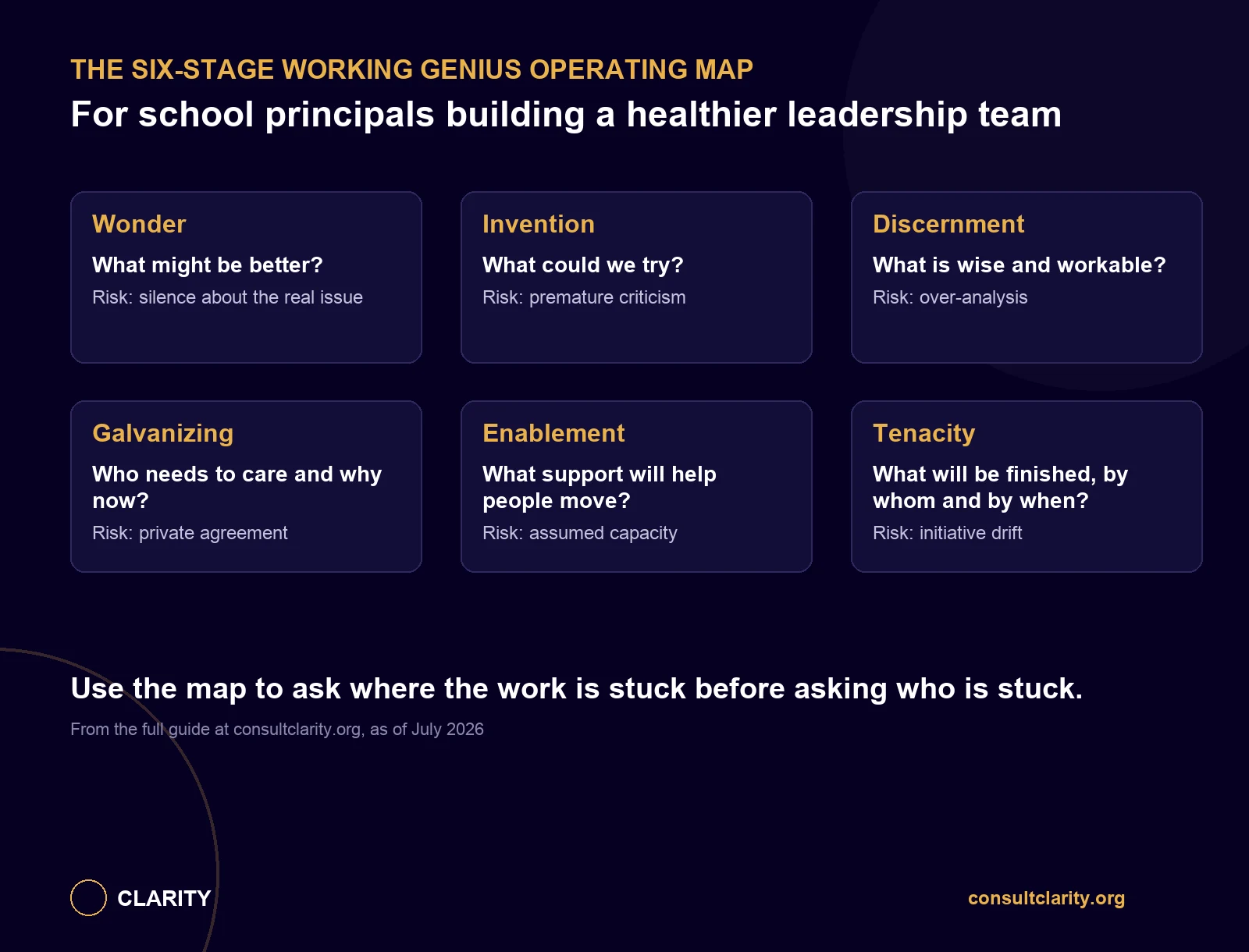
This work-first map changes the conversation. Instead of saying, I am Wonder and you are Tenacity, the team can say, this piece of work has skipped Discernment, or this initiative has no Tenacity owner, or we are asking one deputy to carry Enablement for everyone. That language is cleaner, less personal and easier to act on.
How can Working Genius improve school leadership meetings?
Working Genius improves meetings when it gives every meeting a visible workflow. Most leadership meetings become unhealthy when they mix stages without naming them: people brainstorm while others are evaluating, someone tries to decide while others are still wondering, and the principal leaves with the follow through because nobody owned Tenacity.
A healthier meeting names the stage. If the team is in Wonder, the purpose is to surface the real issue. If it is in Invention, the purpose is to generate possible approaches. If it is in Discernment, the purpose is to test fit, risk and timing. If it is in Galvanizing, the purpose is to prepare momentum. If it is in Enablement, the purpose is to name support. If it is in Tenacity, the purpose is to close loops.
The principal can use a simple discipline at the start of each agenda item: which genius does this item need most today? A behaviour issue may need Wonder before action, because the surface incident is not the real pattern. A curriculum change may need Discernment before Galvanizing, because the team is excited but unclear. A staff wellbeing plan may need Tenacity, because everyone agrees it matters but nobody has made it operational.
This also helps quieter members of the team. Someone with strong Discernment may not speak early in an ideation-heavy meeting because the room seems to reward enthusiasm. Someone with strong Enablement may not name practical barriers because they do not want to sound negative. When the meeting stage is named, the team invites the right contribution at the right moment.
For a deeper guide to workshop design, read the Clarity post on how to run a Working Genius workshop: https://www.consultclarity.org/post/run-working-genius-workshop. A workshop can introduce the language, but the weekly meeting is where the language either becomes useful or disappears.
How does this help reduce hidden load?
Working Genius helps reduce hidden load by making invisible energy costs discussable. It does not remove the workload created by staffing gaps, compliance demands or student complexity, but it can stop a leadership team from adding unnecessary friction to an already heavy job.
Hidden load often gathers around the principal. People escalate half-formed problems because the team lacks Wonder or Discernment routines. People bring ideas without implementation owners because Galvanizing feels like enough. People agree in meetings but leave the principal to chase action because Tenacity has not been assigned. Over time, the principal becomes the default bridge across every missing genius.
That is why the wellbeing data matters. When 86 percent of senior leaders in the Education Support index report feeling stressed and 81 percent say they have too much to do and not enough time, the answer cannot simply be, be more resilient. A healthier team has to redesign how work is shared, sequenced and completed.
The practical move is to review the leadership team's actual calendar and projects through the six stages. Which stage currently depends on the principal? Which stage is overrepresented? Which stage is missing? Which person is spending the most time in frustration work? Which recurring meeting could be redesigned so the load is spread more honestly?
The most powerful sentence in this process is, we are not asking who is busy, we are asking where the work is unhealthy. That keeps the conversation away from blame and closer to design.
How can principals use Working Genius to make decisions cleaner?
Working Genius makes decisions cleaner by separating possibility, design, evaluation, mobilisation, support and completion. A school leadership team often suffers because those movements are collapsed into one conversation, so the loudest or most urgent energy wins.
A principal can use the six stages as a decision path. Wonder asks whether the problem is worth solving. Invention creates options. Discernment tests those options against mission, timing, staff capacity and student need. Galvanizing prepares the message. Enablement identifies support for staff. Tenacity defines completion.
The order matters, but it does not need to be rigid. Some decisions need quick movement. Some need more consultation. Some need a formal project plan. The point is not to make the process heavy. The point is to stop pretending every conversation is the same kind of conversation.
This is especially helpful for school improvement initiatives. A literacy strategy, behaviour reset, timetable change, wellbeing approach or professional learning plan will fail if it skips stages. A brilliant idea without Discernment can become expensive noise. A wise decision without Galvanizing can become private leadership agreement. A strong launch without Enablement can create staff cynicism. A supported initiative without Tenacity can fade into the next term.
The principal's role is not to personally supply every missing stage. The role is to notice the missing stage early enough that the team can respond.
How should this transfer to middle leaders and project teams?
Working Genius should transfer to middle leaders only after the leadership team has practised it enough to use it calmly. When the senior team has lived the language, middle leaders experience it as practical help rather than a message being pushed down the hierarchy.
The transfer point is not a whole-staff lecture. It is a real piece of work. A principal might use the model with heads of department planning a curriculum change, year level leaders responding to student wellbeing needs, or an operations team redesigning an event. The question stays grounded: where is this work getting stuck?
Middle leaders often carry translation pressure. They receive strategic intent from the executive team and emotional reality from staff. Working Genius can help them name whether the blockage is unclear possibility, weak ideas, insufficient evaluation, low momentum, missing support or poor follow through.
The model also gives middle leaders permission to ask for the kind of help they actually need. A head of department strong in Tenacity may need someone else to help with Wonder before action becomes too narrow. A deputy strong in Galvanizing may need Discernment before launching another message to staff. A coordinator strong in Enablement may need Tenacity support so their responsiveness does not become endless availability.
Used this way, Working Genius becomes a shared operating language across the school. It does not replace professional judgement, instructional expertise or pastoral wisdom. It helps those things move through a team with less waste.
What ethical boundaries should principals set?
The ethical boundary is simple: Working Genius is a tool for understanding contribution, not a box for limiting people. A principal should never let the model become an excuse for lowering expectations, denying opportunity, stereotyping staff or explaining away poor behaviour.
There are three lines I would hold firmly. First, do not say, you are not good at that, because it is your frustration. The better sentence is, this kind of work may cost you more energy, so what support or structure would help? Second, do not use someone's genius as a permanent job description. People are whole professionals, not six-letter profiles.
Third, do not use the model to avoid hard conversations. If someone repeatedly fails to follow through, the issue may involve Tenacity, but it may also involve clarity, capacity, skill, motivation or accountability. Working Genius can inform the conversation. It should not replace the conversation.
Principals should also be careful with confidentiality. A team map can help the group, but individual results should be handled with consent and care. The more vulnerable the staff culture, the more slowly the principal should move.
The goal is dignity. People should leave a Working Genius conversation feeling more understood and more responsible, not more labelled.
What do most principals get wrong when they introduce Working Genius?
Most principals get Working Genius wrong by making it either too light or too heavy. Too light means it becomes a fun session with no operational follow through. Too heavy means it becomes another improvement system with forms, language and compliance pressure. Both approaches miss the point.
The first mistake is launching it to everyone before the leadership team has changed anything. Staff will notice the gap between language and practice. If meetings still waste time, initiatives still drift and the principal still carries every unresolved issue, the model will look cosmetic.
The second mistake is using it to explain people rather than work. The sentence, that is just because you are high Discernment, can shut down a person quickly. The better sentence is, this conversation may need Discernment now, so what risks are you seeing?
The third mistake is treating the assessment as the main event. The assessment is useful, but the value comes from applying the language to real work. A team map sitting in a drawer does not make a team healthier.
The fourth mistake is ignoring the missing genius. Teams like celebrating strengths, but the practical value is often in the gap. If nobody naturally brings Galvanizing, the team must design momentum. If nobody naturally brings Tenacity, the team must design closure. If nobody naturally brings Wonder, the team must protect space for better questions.
For more activity ideas, the Working Genius team building post may help: https://www.consultclarity.org/post/working-genius-team-building. The warning is to treat activities as practice for real work, not substitutes for it.
What is a realistic term-long implementation rhythm?
A realistic term-long rhythm keeps Working Genius small enough to use and serious enough to matter. A principal does not need a year-long rollout plan before beginning. The first term should prove whether the leadership team can use the model to improve how it works.
In week one, introduce the six geniuses and agree on the ethical boundaries. In week two, map the leadership team's current work before discussing individual profiles. In week three, complete or revisit the assessment and build the team map. In week four, redesign one recurring leadership meeting using the six stages.
In weeks five and six, choose one live initiative and move it deliberately through Wonder, Invention, Discernment, Galvanizing, Enablement and Tenacity. In week seven, review hidden load by asking which stage the principal is carrying too often. In week eight, transfer the language to one middle leader project, but only if the senior team can explain how it has already changed its own practice.
In week nine, name what is working and what is forced. In week ten, decide whether to continue, scale, pause or simplify. This final decision matters because Working Genius should not become another thing the school maintains out of guilt.
The rhythm works because it respects school reality. It creates enough repetition for shared language, enough restraint to avoid initiative fatigue, and enough evidence for staff to see that the leadership team is applying the model to itself first.
Frequently Asked Questions
What is the simplest way for a principal to explain Working Genius?
Working Genius is a language for the six kinds of work every project needs: Wonder, Invention, Discernment, Galvanizing, Enablement and Tenacity. The simplest explanation is that some stages give people energy, some are manageable, and some drain them quickly.
For school teams, I would explain it as a way to understand work, not personality. The question is not, what type of person are you? The question is, which part of the work brings your best contribution, and which part needs support?
Should every staff member take the assessment straight away?
No, not usually. A principal should normally start with the leadership team, apply the language to real work, and only then decide whether the wider staff will benefit from it.
That sequence protects staff from another initiative that sounds good but changes little. It also gives the senior team time to learn the ethical boundaries before asking others to be vulnerable about frustration zones.
Can Working Genius help with staff wellbeing?
Working Genius can help with staff wellbeing, but only as part of broader work design. It can reveal where people are spending too much time in draining work, where the leadership team is creating friction, and where support or follow through is missing.
It should not be sold as a wellbeing cure. Workload, staffing, student needs, violence, parent pressure and system demands are real. The model helps a team reduce avoidable waste inside those realities.
How is Working Genius different from a personality test?
Working Genius is different because it focuses on contribution and energy in work rather than broad personality traits. It asks where a person naturally contributes to the workflow from possibility to completion.
That makes it especially practical for meetings, projects and school improvement work. A team can use the model to ask which stage a decision needs, not simply what each person is like.
What should a principal do if the team is missing one of the six geniuses?
The principal should treat a missing genius as a design issue, not a character flaw. If the team lacks Galvanizing, it needs a deliberate communication and momentum plan. If it lacks Tenacity, it needs clearer ownership, deadlines and closure rituals.
Missing genius areas do not mean the team cannot do the work. They mean the team should stop assuming the work will happen naturally.
How do you stop Working Genius from becoming a label?
You stop it becoming a label by keeping the conversation anchored to work and by using consent, humility and precision. Avoid saying, you are this, so you always do that. Say, this stage of work may energise you, and this stage may cost more.
The principal must model that discipline. When the leader uses the language carefully, others learn that the framework is for clarity, not shorthand judgement.
Final Thoughts
Working Genius can help school principals build healthier teams because it gives the team language for what is usually invisible. It names the movement from wondering to finishing, and it helps people see where energy, frustration, momentum and follow through are actually sitting.
The deepest benefit is not the profile. It is the conversation the profile makes possible. A leadership team can finally say, we have plenty of ideas but no closure, or we are evaluating before we have imagined enough, or we are asking the principal to carry every missing stage.
That kind of clarity is not a luxury in schools. When principal wellbeing, staff stress and initiative fatigue are this real, leadership teams need practical ways to reduce waste and distribute work more honestly.
If you are wrestling with this inside your own team, it is the kind of work I do. If that is you, reach out and I would be glad to help, since helping people through exactly this is what I specialise in. You can reach me at jonno@consultclarity.org.
About me: I am a Certified Working Genius Facilitator, certified through Patrick Lencioni's Table Group, and the author of Step Up or Step Out. I work with schools, corporates, and nonprofits around the world. If that is useful for your team, you can reach me at jonno@consultclarity.org.
Sources: Patrick Lencioni, The 6 Types of Working Genius, listed at https://en.wikipedia.org/wiki/Patrick_Lencioni. RAND Corporation, Restoring Teacher and Principal Well-Being Is an Essential Step for Rebuilding Schools, https://www.rand.org/pubs/research_reports/RRA1108-4.html. Education Support, Teacher Wellbeing Index, https://www.educationsupport.org.uk/resources/for-organisations/research/teacher-wellbeing-index/. Australian principal wellbeing reporting, https://www.theguardian.com/australia-news/2025/mar/31/australia-could-lose-entire-generation-principals-ntwnfb and https://www.couriermail.com.au/news/two-in-three-nt-principals-assaulted-threatened-in-2023-according-to-report/news-story/e2dbf0c5c7512040a5b7b2898b795728.
Next read: Working Genius in schools, https://www.consultclarity.org/post/working-genius-schools.