How to Choose the Right Keynote Speaker When Half the Room Is Somewhere Else
By Jonno White
Last updated: July 2026
If you want to choose the right keynote speaker for your conference, stop asking who will hold the room and start asking whose material will leave it. As of July 2026, the research on how professionals actually learn at events has moved faster than the way most committees score a shortlist. Only about half of attendees now sit in keynote sessions at all, and the ones who do say they would rather spend most of their learning time somewhere else entirely.
That changes what you are buying. The problem that looks like a weak speaker is usually a speaker whose material could not travel, because the session was built to work inside the room rather than to be repeated outside it. My argument is that portability, not performance, is now the property that separates a keynote that pays for itself from one that rates well and changes nothing.
By the end of this piece you should be able to rescore your shortlist, run a sharper reference call, and write a brief that makes the content usable by people who were never in the ballroom.
Key Takeaways
Only about half of your delegates will be in the room for the keynote, so the session has to work for people who hear about it second-hand.
Attendees now say they would ideally do most of their learning outside session rooms, which makes portability the single property worth optimising for.
How much an audience enjoyed a session barely predicts what they learned, while their judgement of whether it was useful predicts what they later do far better.
The most reliable selection test is whether a delegate can repeat the idea to a colleague who was not there, and have that colleague know what to do differently on Monday.
The keynote's job changed while the brochure stayed the same
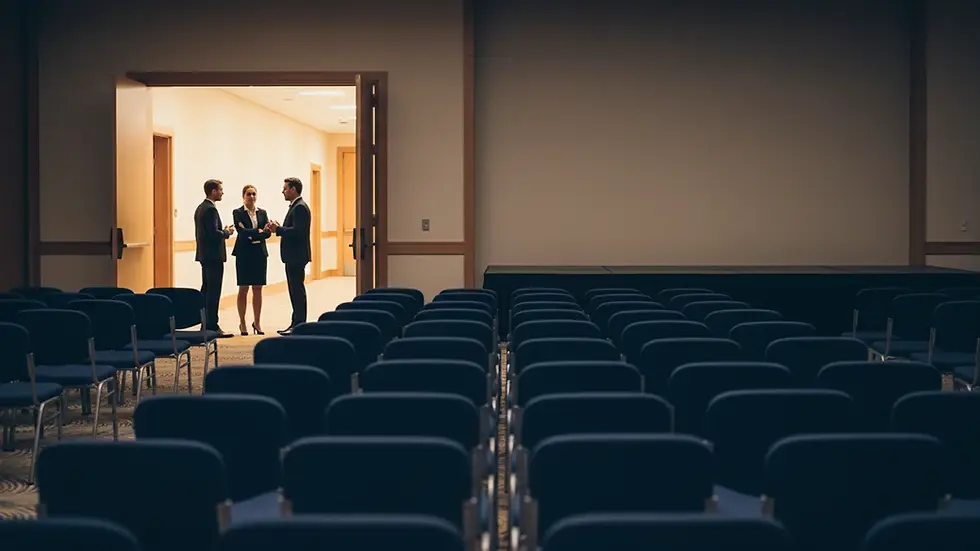
The keynote is no longer the event's centre of gravity, and the numbers are not subtle about it. In research published in April 2026, Freeman found that while only about half of attendees participate in keynote sessions, many choose to spend that time elsewhere across the event experience. The main stage has become one option among several rather than the default.
This is not a story about conferences losing their value. The same study found that 70 per cent of attendees rank live events as their primary learning channel, ahead of webinars, on-demand platforms and social channels. In-person events are winning. It is the general session, specifically, that has lost its monopoly.
Most selection processes have not caught up. The scoring sheet still rewards the qualities that matter when a room is full and captive: presence, pacing, story, applause. Those qualities are real, and I am not arguing they are worthless. I am arguing that they are now necessary rather than sufficient, because a growing share of the people whose registration you are trying to justify will experience your keynote as a summary from a colleague, a photo of a slide, or a line in a conference wrap-up email.
Why the room is no longer the test
If you design the keynote for the room, you are designing for a minority of the learning. Freeman's follow-up research, published on 23 July 2026 and based on more than 3,300 attendees and exhibitors, found that attendees would ideally spend 54 per cent of their learning time outside traditional session rooms. At trade shows that figure rises to 64 per cent.
The same study found something more pointed for anyone building a program. Attendees rate learning from networking and exhibitor engagement as slightly more valuable than traditional conference sessions. Two-thirds of emerging generations say they want more learning opportunities outside traditional conference rooms.
Read those findings together and the implication for speaker selection is direct. The hours your delegates value most are the hours when your speaker is not talking. So the question is not whether the speaker can fill forty-five minutes well. It is whether what they say in those forty-five minutes gives people something to do with the rest of the day.
That is a genuinely different criterion, and it is not the one most showreels are edited to demonstrate.
The signal most committees are reading is the wrong one
Session ratings feel like evidence and mostly are not. The most rigorous work on this question comes from training evaluation, where researchers have spent decades asking whether how much people liked a session tells you anything about what changed afterwards. The answer is consistently uncomfortable.
In a meta-analysis of training criteria drawing on 34 studies and 111 correlations, Alliger and colleagues reported that the overall average correlation between reactions of any type and immediate learning was only .08. Their conclusion was blunt: liking does not equate to learning or to performing.
The interesting part is what did predict application. Reactions that asked about usefulness, rather than enjoyment, correlated .18 with on-the-job performance, while purely affective reactions managed .07. Utility judgements even outperformed immediate learning scores, which sat at .11. The plausible mechanism is that a person asked whether something will be useful is quietly assessing two things at once, the content and the conditions they are going back to.
Two caveats before anyone over-reads this. These are modest correlations across workplace training, not keynote speeches, and applying them to a conference stage is an argument rather than a measured finding. Reactions also still matter commercially, because a session that lands badly damages a program regardless of what anyone learned.
Even so, the direction is clear, and it lines up with what organisers themselves get wrong. Freeman's April 2026 study reported that event organisers consistently overestimate the effectiveness of education sessions, particularly in delivering real-world relevance and actionable takeaways. Ken Holsinger, SVP of Strategy at Freeman, put the shift plainly: "We're entering a new era of learning where people don't measure value by how much content they consume, but by what actually changes after they leave."
How to choose the right keynote speaker: four questions that test portability
Here is a practical way to apply all of that to a real shortlist this week. These four questions are not a framework and they are not mine. They are a reading of the research above, turned into something you can score. Use them on the showreel, on the reference call, and on the speaker themselves.
Can a delegate repeat the core idea in one sentence?
This is the whole thesis compressed into one test. Watch the showreel and write down, in one sentence, what a delegate would tell a colleague who was not there. If you cannot do it after watching, your delegates will not manage it after listening.
A good answer sounds like a claim someone could disagree with. A weak answer sounds like a theme, and themes do not survive the corridor.
Does the material give people something to do, or only something to feel?
Feeling is not the enemy, and a room that never moves emotionally is a room that stops listening. The test is whether the emotion is attached to a decision, a question, or a way of looking at a problem that a delegate can actually apply. Ask the speaker directly what they expect a delegate to do differently on Monday, and listen for whether the answer is specific enough to be wrong.
What do previous clients say about the following six weeks?
Most reference calls ask how the session went, which collects exactly the affective reaction the research warns you about. Ask instead what people were still talking about a month later, what the speaker's language did to internal conversations, and whether anything visible changed. If a previous client can only offer that everyone loved it, you have learned something useful about portability, and it is not encouraging.
Will they build for your event, or bring their event to you?
Ask how much pre-event discovery they do, who they talk to, and what they would change if your audience turned out to be more sceptical than your brief suggested. A speaker who cannot describe how they would adapt is offering you a fixed asset. That is fine if you want a shared moment. It is a poor buy if you want material that keeps working after the applause.
The brief is part of the selection, not paperwork that follows it
Whoever you choose, the brief determines how far the content can travel, so treat writing it as the second half of the decision rather than an administrative task. Most briefs describe the audience, the theme and the timings. Very few describe what the organiser wants delegates to be able to say to someone who was not in the room.
Imagine a program lead who books a strong speaker on organisational change and briefs them on the sector, the delegate mix and the fifty-minute slot. The session goes well. Six weeks later nobody can reconstruct the argument, because the brief never asked for one portable idea and the speaker, reasonably, optimised for the room they were given.
The fix is small and unglamorous. Name the one sentence you want repeated. Ask for a question delegates can take into their next leadership meeting. Tell the speaker where the rest of the learning happens at your event, because if 54 per cent of the value sits outside the session room, the speaker should know what they are setting up.
Then change the evaluation question. Instead of asking delegates how much they enjoyed the session, ask what they intend to do differently and who they will talk to about it. On the evidence above, that question is a better predictor of anything that matters, and it costs nothing to change.
When the conventional answer is still right
The strongest objection to everything above is that the keynote is not primarily a learning intervention at all. It is the one moment the whole conference shares, the name that sells the ticket, and the headline the sponsors see. Optimise it for portability and you may end up with a useful session that nobody registers for, which helps no one.
That objection deserves more respect than it usually gets, and part of the evidence complicates my own argument. Freeman's May 2026 research, drawing on nearly 20,000 responses from people inside an event's target audience who had not attended, found that 60 per cent of non-attendees would be more likely to attend if events offered education only available in person.
Notably, the same research found that traditional draws such as after-hours events and entertainment rank among the least influential factors in driving audience decisions. So the reflex to buy spectacle is weakly supported, but the reflex to buy a genuine reason to be in the room is strongly supported. Those are not the same thing, and conflating them is how committees end up paying celebrity money for a session that could have been a video.
There are also events where the main-stage name genuinely is the product. If your conference is built around a single figure whose presence is the reason people fly in, portability is a secondary concern and you should say so out loud rather than pretending otherwise. The same applies to ceremonial or tone-setting slots, such as an opening address whose job is to mark the occasion.
What this evidence cannot tell you
I would rather state the limits than let the numbers do more work than they can bear. The 2026 findings are stated preferences from surveys of 4,700 attendees and 185 organisers in April, more than 3,300 attendees and exhibitors in July, and nearly 20,000 non-attendees in May. Stated preference is not observed behaviour, and none of it is a controlled test of speaker selection.
The meta-analysis is stronger methodologically but sits in a different setting. It measures workplace training, drawn from 34 studies and 111 correlations, and the newest of that work is decades old. Carrying it across to a conference keynote is a reasoned argument, not a demonstrated result.
There is also something missing from this page that I want visible rather than glossed. I have not put original data from my own speaking or facilitation work in front of you here, and no anonymised client outcomes appear above. Everything I have argued is a reading of public evidence plus my own reasoning, and you should weigh it accordingly.
Finally, none of this tells you about your audience specifically. A membership that is highly homogeneous and genuinely captive may behave nothing like the survey averages.
Frequently Asked Questions
How much should we expect to pay for a conference keynote speaker?
Fees vary enormously by market, profile and format, so treat any single range as indicative rather than authoritative. The more useful question is what the fee buys beyond the session itself, since pre-event discovery, a breakout, or a follow-up resource often changes outcomes more than a larger name does. If a speaker cannot explain what happens outside their slot, you are paying for forty-five minutes.
How far in advance should we book?
Well-known speakers are commonly booked six to twelve months ahead, and the more in-demand the name, the longer the lead time. The practical constraint is usually your own committee calendar rather than the speaker's diary. Build in time for a real briefing conversation, because a rushed brief is the most common way a good booking underperforms.
How do we tell afterwards whether the keynote actually worked?
Change the question you ask delegates. Enjoyment ratings correlate weakly with learning, so ask instead what people intend to do differently, who they plan to discuss it with, and whether they can state the central idea in their own words. Only 19 per cent of attendees cite continuing education credits as a primary reason for attending, so completion metrics tell you even less than satisfaction scores do.
Final Thoughts
The uncomfortable part of this argument is that it works against the way speakers are usually sold, including the way I could sell myself. Showreels are edited to prove presence. Reference calls are structured to collect warmth. Both are measuring the property that the evidence says predicts the least.
The shift I am proposing is small in practice and large in effect. Keep watching for whether a speaker can hold a room, because that still matters. Then add one more test that most committees skip, and let it carry more weight than it currently does: can what this person says be carried out of the room by somebody who then has to explain it to a colleague who was not there.
If most of the learning at your conference is going to happen in the corridors, the expo floor and the dinner tables, the right keynote speaker is the one who gives those conversations something worth having.
If you are choosing a speaker right now
If you are working through a shortlist for a conference and this is the kind of thinking you want in the room, it is the kind of work I do. You can reach me at jonno@consultclarity.org, or get in touch and tell me about your audience and what you need delegates to be able to do afterwards.
About the Author
I am Jonno White. I speak and facilitate at conferences, offsites and leadership events, and I am a Certified Working Genius Facilitator, certified through Patrick Lencioni's Table Group, and the author of Step Up or Step Out, which has sold more than 10,000 copies. I work with schools, corporates and nonprofits around the world, and I host The Leadership Conversations Podcast, which reaches listeners in more than 150 countries. There is more about how I work if it is useful, and if you want to see what previous clients say about a speaker, what previous clients say is a reasonable place to start.
Sources
Freeman, "Freeman Trends Report: In-Person Events Are the #1 Source of Professional Learning", 16 April 2026. https://www.globenewswire.com/news-release/2026/04/16/3275559/0/en/freeman-trends-report-in-person-events-are-the-1-source-of-professional-learning.html
Freeman, "New Freeman Trends Report Highlights Innovative Research on Why Potential Attendees Don't Attend Conferences and Trade Shows and What Will Bring Them Back", 18 May 2026. https://www.globenewswire.com/news-release/2026/05/18/3296797/0/en/New-Freeman-Trends-Report-Highlights-Innovative-Research-on-Why-Potential-Attendees-Don-t-Attend-Conferences-and-Trade-Shows-and-What-Will-Bring-Them-Back.html
Freeman, "New Freeman Trends Report Finds Attendees Want More Event Learning to Happen Outside the Session Room", 23 July 2026. https://www.globenewswire.com/news-release/2026/07/23/3332147/0/en/new-freeman-trends-report-finds-attendees-want-more-event-learning-to-happen-outside-the-session-room.html
Alliger, Tannenbaum, Bennett, Traver and Shotland, "A Meta-Analysis of the Relations among Training Criteria", Air Force Research Laboratory report AFRL-HE-BR-TR-1998-0130; peer-reviewed version published in Personnel Psychology, 1997. https://apps.dtic.mil/sti/tr/pdf/ADA368508.pdf
Next Read
If you are ready to rebuild the shortlist itself, a ranked directory of association conference speakers covers who is working this market, what the fee bands look like, and how the categories differ.