21 Proven Ways to Beat Leadership Decision Fatigue
It is 3:47 PM on a Thursday. You have been in meetings since 8 AM, answered 63 emails, approved two budgets, navigated a staffing conflict, and now your deputy principal is standing in your doorway asking for a call on next term's timetable. You know this decision matters. You also know your brain checked out about 40 minutes ago.
That moment is not a personal weakness. It is a biological reality called decision fatigue, and it is quietly shaping the quality of leadership in schools, corporates, and nonprofits around the world. Research from Columbia Business School suggests that executives make progressively worse decisions after 4 PM, with quality degrading by as much as 23 percent compared to morning calls. A landmark 2011 study of Israeli parole judges found that favourable rulings dropped from roughly 65 percent at the start of a session to nearly zero before a break, then reset after food and rest.
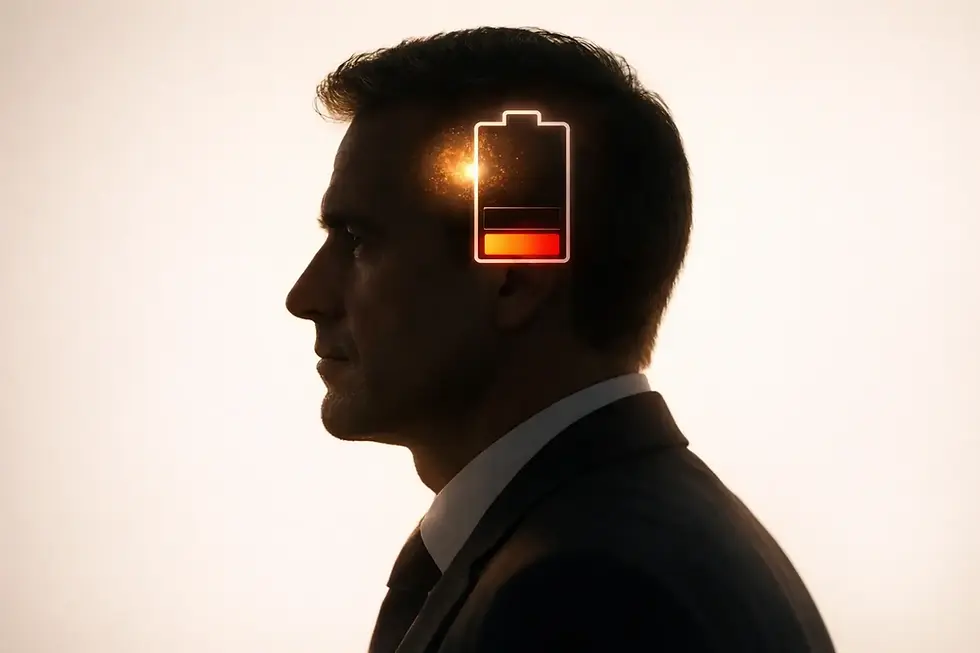
The average adult makes an estimated 35,000 decisions per day. Leaders make considerably more, often under higher stakes. Each one draws from the same finite cognitive reserve in your prefrontal cortex. By mid afternoon, that reserve is running dangerously low, and you are making million dollar calls with the mental equivalent of a flat battery.
This guide exists to change that. These are not vague suggestions to "delegate more" or "take a break." These are 21 specific, research backed strategies that will protect your sharpest thinking for the decisions that actually matter.
Jonno White is a Certified Working Genius Facilitator and bestselling author of Step Up or Step Out who helps leadership teams build systems that protect clarity, alignment, and high performance. To book Jonno for your next keynote, workshop, or executive team offsite, email jonno@consultclarity.org.
Why Leadership Decision Fatigue Matters More Than You Think
Decision fatigue is not the same as being tired. You can be physically rested and still be cognitively depleted. Your prefrontal cortex, the brain region responsible for planning, reasoning, and self control, consumes a disproportionate share of your brain's glucose supply. Sustained decision making drains those reserves in ways most leaders never notice until the damage is done.
When decision fatigue sets in, three things happen. First, you default to the status quo. Instead of engaging with innovative risk taking, you rubber stamp the easiest, safest option on the table. Second, you avoid decisions altogether, pushing critical calls into next week, next month, or never. Third, you become impulsive, saying yes to things you should decline just to end the conversation and get people out of your office.
The organisational cost is enormous. Deloitte estimates that poor mental health costs the UK financial sector more than 5,000 pounds per employee per year. McKinsey research shows that a significant share of senior executives believe bad strategic decisions are at least as frequent as good ones in their organisations. Gallup estimates that disengaged employees cost US businesses up to 605 billion dollars annually, and it often starts at the top when leadership clarity falters.
Here is the uncomfortable truth: the decision you made at 4:30 PM on a Friday to approve that restructure, greenlight that hire, or sign off on that strategy may have been shaped more by cognitive depletion than by sound judgment. The good news is that decision fatigue is not inevitable. It is manageable, and the 21 strategies below will show you exactly how.
Jonno White delivers keynotes and workshops on leadership clarity, team alignment, and high performance for schools, corporates, and nonprofits around the world. Email jonno@consultclarity.org to explore how Jonno might support your leadership team.
Decision Architecture: Change the System So Fewer Decisions Reach You
1. Set Explicit Decision Rights So Everything Stops Landing on Your Desk
The fastest way to reduce your decision load is to stop being the bottleneck. Most leaders are drowning in decisions that should never have reached them in the first place. The fix is a clear decision rights framework, a simple document that defines who decides what, at what threshold, and when escalation is required.
Start by listing the 20 most common decisions in your organisation. For each one, assign an owner using a simple filter: Is this a one way door (irreversible) or a two way door (reversible)? Jeff Bezos popularised this distinction at Amazon, and it remains one of the most practical decision frameworks available. Two way door decisions should almost never reach the CEO or principal. Assign them to the person closest to the work.
Include financial thresholds. Anything under a certain dollar amount gets approved by the relevant team leader. Anything above goes through a brief decision memo process. This single change can remove 30 to 40 percent of the decisions currently consuming your afternoon bandwidth.
2. Turn Recurring Judgments into Policies and Defaults
Every time you make the same type of decision twice, you are wasting cognitive energy that could go toward something original. Policies convert repeated judgment calls into one time design work. Defaults set the standard path so that only exceptions require your attention.
Consider pricing. If clients regularly ask for discounts, create a policy: discounts up to 10 percent are approved automatically for contracts over a certain length. Above 10 percent requires a brief business case. This eliminates the daily drain of negotiating each request from scratch.
The same principle applies to communication channels, meeting formats, reporting templates, and hiring processes. Every policy you create is a decision you never have to make again. Schools that implement clear behaviour management protocols see the same effect. Teachers stop escalating every incident to the leadership team because the policy handles 80 percent of cases automatically.
3. Require "Three Options, One Recommendation" from Every Direct Report
One of the most draining patterns in leadership is when team members bring you raw problems and expect you to generate the solution. This shifts the entire cognitive load onto the person who can least afford it, the leader whose decision battery is already running low.
The fix is simple. Require every direct report to present three potential solutions and one specific recommendation before any decision meeting. This forces the thinking upstream, where it belongs. Your role shifts from generating options (which is exhausting) to evaluating and choosing (which is far less depleting).
Patrick Lencioni's Working Genius framework explains why this matters at a deeper level. Different people are wired to thrive at different stages of work. The person with the Genius of Invention is naturally energised by generating novel ideas. The person with the Genius of Discernment is wired to evaluate them. When you force leaders to do both, they burn out faster.
4. Build Guardrails Instead of Approval Processes
Approval processes feel like control, but they are actually decision factories. Every approval request is another choice landing on your desk, usually at the worst possible time.
Guardrails work differently. Instead of "ask me before you spend anything," you set written constraints: budget ceilings, brand guidelines, security requirements, quality standards. Your team operates freely within those boundaries. Only genuine exceptions require escalation.
This approach does two things simultaneously. It reduces your decision volume by 30 to 50 percent, and it develops your team's decision making confidence. Leaders who replace approvals with guardrails consistently report that their afternoons become dramatically less reactive.
5. Run Quarterly "Decision Debt" Reviews
Decision debt is the accumulation of recurring decisions that should have become policies, automation, or delegated authority months ago. Every organisation has them, and they compound quietly.
Once per quarter, audit the decisions that have crossed your desk in the last 90 days. Look for patterns. Which decisions showed up more than three times? Which ones could be handled by someone else with clear guidelines? Which ones are still sitting unresolved because nobody has the courage to commit?
Convert each recurring pattern into either a policy, a delegation with guardrails, or an automated workflow. This quarterly habit is one of the highest leverage things a leadership team can do to protect their collective decision quality.
Jonno White, Certified Working Genius Facilitator and trusted facilitator across Australia, UK, USA, Singapore, Canada, and beyond, helps executive teams design decision systems that prevent cognitive overload. Email jonno@consultclarity.org to discuss how Jonno might help your leadership team.
Meeting Design: Protect Your Best Thinking from Death by Calendar
6. Separate Decision Meetings from Discussion Meetings
Most meetings combine brainstorming, debating, and deciding into one undifferentiated block. This is catastrophic for decision quality. Your brain uses fundamentally different resources for generating ideas (divergent thinking) versus evaluating and choosing (convergent thinking). Forcing both into the same session depletes you twice as fast.
Label every meeting explicitly. "Discussion" meetings are for exploring options and generating data. "Decision" meetings are for choosing. Never combine the two. When your team knows what type of meeting they are walking into, everyone arrives with the right mental energy and the right expectations.
This single change can cut your meeting cognitive load by 30 percent or more.
7. Implement Decision Memos for Any Call Over a Certain Impact
Amazon's six page memo culture exists for a reason. When important decisions are presented verbally in meetings, the quality of the decision depends on the persuasiveness of the speaker, the time of day, and the energy level of everyone in the room. When decisions are presented in writing, the quality depends on the strength of the reasoning.
Require a one page decision memo for any call above a certain financial or strategic threshold. The memo should include: the decision to be made, the options considered, the recommended option, the trade offs, and what would change your mind. Participants read the memo in silence for the first five minutes of the meeting, then discuss.
This moves the heavy cognitive lifting to the memo writer (who can do it at their peak time) and reduces the leader's role to evaluation, which is far less depleting than listening to a 20 minute verbal pitch.
8. Default to 45 Minute Meetings with Built In Recovery Buffers
Back to back 60 minute meetings are one of the most reliable ways to destroy your afternoon decision quality. Each meeting requires a context switch. Research from the NeuroLeadership Institute shows that context switching activates stress pathways and reduces the brain's capacity for careful analysis.
Shrink every default meeting to 45 minutes. Use the remaining 15 minutes as a cognitive recovery buffer. Stand up. Look at a distant point (this relaxes your ocular muscles and shifts your brain from hyper focus to diffuse thinking). Write down the one decision or outcome from the meeting you just left. Then, and only then, walk into the next one.
Leaders who build recovery buffers between meetings consistently report sharper thinking in their afternoon sessions.
9. Ban Surprise Decisions in Meetings
If a decision was not on the pre circulated agenda with a brief, it becomes a "discuss, not decide" item. Period. Surprise decisions force leaders to make high stakes calls with no preparation, no time for the prefrontal cortex to do its analytical work, and no opportunity to consult relevant data.
This rule alone will prevent most of the regrettable snap calls that leaders make in the last meeting of the day. It also teaches your team to plan ahead and present decisions with the preparation they deserve.
The judicial parole study showed that judges defaulted to the safest option (denial) when they were depleted. Leaders do the same thing. Unprepared, fatigued leaders say no to good ideas, yes to bad ones, or defer everything to next week. Banning surprise decisions protects against all three patterns.
Energy Management: Align Your Calendar with Your Brain
10. Front Load Your Hardest Decisions Before 11 AM
Your prefrontal cortex operates like a battery. It starts the day fully charged and depletes with every decision, conversation, and context switch. For most people, peak cognitive capacity falls between 8 AM and 11 AM. This is when your analytical thinking, risk assessment, and impulse control are at their strongest.
Guard this window fiercely. No email triage. No routine catch ups. No "quick chats" that turn into 40 minute problem solving sessions. Use your first three hours for the decisions that carry the highest stakes and the greatest complexity.
Daniel Pink's research on chronotypes confirms that while individual peak times vary, the afternoon trough is nearly universal. Whatever your chronotype, your worst cognitive window is almost certainly between 2 PM and 4 PM. Plan accordingly.
11. Use Strategic Refuels, Not Just Breaks
The parole judge study contained a finding that most articles overlook. Decision quality did not just decline over time. It reset to baseline after every break. The mechanism was not rest alone. It was food, movement, and a complete cognitive disconnection from the decision stream.
A "strategic refuel" is different from checking your phone on the couch. It means 10 to 15 minutes of genuine cognitive disengagement: a walk outside, a conversation about something completely unrelated, or simply staring out a window. These moments allow your prefrontal cortex to partially recover, clearing some of the adenosine buildup that impairs executive function.
Schedule refuels before your most important afternoon decisions, not after them. This is a performance tool, not a luxury.
12. Front Load Emotionally Difficult Decisions
Decisions that carry consequences for other people, layoffs, performance conversations, difficult feedback, strategic pivots that affect teams, draw on both cognitive and emotional resources. They deplete your reserves faster and recover slower than routine operational decisions.
If your morning is filled with people related calls, your afternoon strategic thinking will suffer more than if you had spent the morning on logistics. This is the "emotional labour multiplier" that most decision fatigue articles completely miss.
Research by Kouchaki and Smith at Harvard found that people are measurably more likely to engage in ethically questionable behaviour in the afternoon than in the morning. They called it the "morning morality effect." The mechanism is the same: as self regulatory resources deplete, the brain's ability to resist the easy path weakens. Handle the hard conversations first, while your moral compass and emotional resilience are at full strength.
13. Replace Afternoon Sugar Hits with Protein and Complex Fats
The relationship between glucose and decision quality is more nuanced than most people realise. Your brain runs on glucose, but a sugary snack creates a rapid spike followed by a crash that makes the afternoon slump significantly worse. The crash impairs prefrontal cortex functionality at exactly the moment you need it most.
Research from Stanford (Job, Dweck, and Walton, 2010) added an important nuance: willpower depends on glucose drops primarily when the individual believes willpower is a limited resource. The psychological framing matters. But the practical takeaway is simple. Replace afternoon sweets with protein, complex carbohydrates, and healthy fats. Nuts, yoghurt, cheese, or a balanced meal will sustain cognitive performance far longer than a chocolate bar.
Keep glucose volatility low before any critical decision block. Large swings increase perceived fatigue and impulsive choices.
14. Use a 90 Second Physiological Reset Before Critical Calls
Before any high stakes decision in the afternoon, take 90 seconds for a deliberate physiological reset. Three deep breaths (inhale for 4 seconds, hold for 4, exhale for 6). Splash cold water on your face. Stand up and stretch. This is not wellness theatre. It is neuroscience.
These actions downshift your nervous system from sympathetic (fight or flight, reactive) to parasympathetic (calm, analytical). When you are in a stress arousal state, your brain relies more heavily on heuristics and less on careful reasoning. A brief physical reset shifts you back toward deliberate, System 2 thinking.
The best leaders build this into their routine. Ninety seconds between a frustrating email and a strategic decision can be the difference between a call you regret and one you are proud of.
Jonno White, host of The Leadership Conversations Podcast with 230 plus episodes reaching listeners in 150 plus countries, works with leadership teams to build energy management systems that sustain high performance. Email jonno@consultclarity.org to learn more.
Cognitive Load Reduction: Fewer Open Loops, Fewer Bad Calls
15. Batch Similar Decisions into Dedicated Blocks
Context switching is the hidden villain of decision fatigue. Every time you shift from a hiring decision to a budget approval to a marketing sign off, your brain burns energy reloading the relevant context. Research on CEO time use from Harvard Business School (Bandiera, Guiso, Prat, and Sadun) shows that CEO work is overwhelmingly meeting driven, which is a practical proxy for constant context switching.
The antidote is decision batching. Group similar decisions into dedicated blocks. Tuesday morning is hiring decisions. Wednesday afternoon is budget approvals. Thursday is content and marketing sign offs. When your brain stays in one mode, each subsequent decision in that category becomes faster and less depleting.
This is the same principle behind Patrick Lencioni's Working Genius model. When people work in their areas of genius, they have more energy at the end of the day, not less. When they constantly switch between tasks that require different types of energy, they deplete faster.
16. Create If Then Rules for Common Edge Cases
Every organisation has recurring edge cases that consume disproportionate decision energy. A client asks for a discount. A staff member requests an exception to the leave policy. A vendor misses a deadline. If you are deciding each of these from scratch every time, you are burning premium cognitive fuel on low value work.
Write if then rules for your ten most common edge cases. If a client requests a discount over 15 percent, then require an upsell on contract length. If a staff member requests leave during a blackout period, then the request goes to the deputy for assessment against a published criteria. If a vendor misses a deadline by more than five days, then trigger a formal review.
These rules replace active decision making with automated rule following. Your brain shifts from effortful deliberation to simple pattern matching, which consumes a fraction of the cognitive resources.
17. Close Your Open Loops Before They Compound
One of the most overlooked aspects of decision fatigue is the drain caused by unmade decisions. Every choice sitting in the back of your mind, the email you have not responded to, the conversation you are avoiding, the proposal you have not reviewed, creates what psychologists call an "open loop." Each open loop occupies working memory and reduces your available capacity for active decisions.
At the end of each day, spend 10 minutes on a "capture, not solve" exercise. Write down every unresolved decision with the next action, the owner, and the deadline. This transfers the cognitive load from your working memory to an external system. Research on the Zeigarnik effect confirms that the brain holds onto incomplete tasks until they are either completed or captured in a trusted system.
Leaders who do this consistently report better sleep, less rumination, and sharper morning decision quality.
18. Build a Single Source of Truth Dashboard
Decision fatigue is amplified by uncertainty. When leaders have to hunt for data, cross reference conflicting reports, or ask three people the same question to get one answer, they burn cognitive energy before they even start deciding.
Build one dashboard that shows the five to ten metrics that matter most to your organisation. Update it automatically or with minimal manual input. When a decision requires data, everyone looks at the same numbers. This eliminates re checking, re arguing, and the decision tax of interpreting conflicting information.
The goal is not more data. It is less ambiguity. After a certain threshold, more information creates analysis paralysis, which actually increases cognitive load and accelerates fatigue. Give yourself clear, simple, trusted numbers and decide.
Team Structure: Distribute the Decision Load
19. Create Decision Pods with Designated Deciders
If every consequential decision flows through one person, that person will be cognitively impaired by mid afternoon regardless of how brilliant they are. The solution is structural, not personal.
Create decision pods for each major domain: people, operations, product, finance, and culture. Each pod has a designated decider who owns final calls within that domain. The CEO or principal provides the strategic frame and intervenes only on one way door decisions that cross domains.
Bain's RAPID framework (Recommend, Agree, Perform, Input, Decide) formalises this beautifully. When every team member knows their role in the decision process, the leader's cognitive load drops dramatically without losing strategic control.
20. Install a Red Team Role for High Stakes Calls
One of the most depleting leadership habits is constantly playing devil's advocate. When you are the only person challenging assumptions, probing risks, and asking hard questions, you burn through cognitive reserves at double speed because you are simultaneously holding the original position and generating the critique.
Install a rotating "red team" role in your leadership meetings. One person is specifically accountable for finding flaws in the proposed plan. This distributes the cognitive work of critical thinking and ensures that challenge happens even when the leader is depleted.
A quick two minute pre mortem before any major decision achieves a similar effect. Ask the team: "Imagine it is six months from now and this decision failed completely. Why?" This surfaces hidden risks without requiring the leader to carry the entire burden of skepticism.
21. Use Working Genius to Align Energy with Contribution
Here is where most decision fatigue advice falls short. It treats every leader as interchangeable. It assumes that the same strategies work for every person in every role. But the reality is that leaders are wired differently, and the type of work that drains one person energises another.
Patrick Lencioni created the Working Genius model to address exactly this problem. The assessment identifies six types of work: Wonder, Invention, Discernment, Galvanizing, Enablement, and Tenacity. Everyone has two that energise them (their working geniuses), two they can manage (their competencies), and two that drain them (their frustrations). Over 1.3 million people have completed the assessment globally in under five years, making it the fastest growing team productivity tool available.
When leaders spend their peak hours doing work that aligns with their genius, they have more energy at the end of the day, not less. When they spend the morning grinding through their frustration areas, they arrive at the afternoon already depleted, making every subsequent decision worse.
A Working Genius facilitated session with your leadership team can reveal exactly where the energy misalignment is hiding. It explains why certain meetings feel like caffeine while others feel like quicksand. It shows why projects stall, why handoffs break down, and why some leaders burn out faster than others despite similar workloads.
Jonno White is a Certified Working Genius Facilitator who delivers Working Genius sessions for schools, corporates, and nonprofits around the world. His book Step Up or Step Out has sold over 10,000 copies globally. To book Jonno for a Working Genius session, keynote, or executive team offsite, email jonno@consultclarity.org. International travel is often far more affordable than clients expect.
Common Mistakes Leaders Make with Decision Fatigue
The first mistake is treating decision fatigue as a time management problem. It is not. You can have a perfectly organised calendar and still be cognitively destroyed by 2 PM if every meeting involves high stakes choices. The issue is decision volume, decision difficulty, and context switching, not how many hours you work.
The second mistake is believing that discipline and willpower are the solution. "Gritting it out" does not build mental endurance. It damages decision quality. Your prefrontal cortex is a biological system with recoverable limits, and pushing through those limits does not make them expand. It makes them collapse faster.
The third mistake is reaching for sugar. While your brain runs on glucose, sugary snacks create a spike and crash cycle that makes the afternoon trough worse, not better. The crash impairs executive function at exactly the wrong moment.
The fourth mistake is assuming that only big decisions cause fatigue. The brain processes the volume of decisions as heavily as the weight of them. Choosing what to eat for lunch drains from the same cognitive tank as choosing whether to restructure a department.
The fifth mistake is delegating without guardrails. Delegation without clear decision rights, thresholds, and if then rules does not reduce your cognitive load. It just moves confusion around and boomerangs back as escalations, usually at 4 PM when you can least handle them.
The sixth mistake is waiting indefinitely. Delay itself is a low quality decision. While "sleeping on it" is wise for genuinely complex calls, chronic avoidance is often decision fatigue disguising itself as prudence. The 70 percent rule, making the call when you have 70 percent of the information you wish you had, is a powerful antidote.
The seventh mistake is believing coffee solves everything. Caffeine masks depletion but does not restore cognitive capacity. Worse, poorly timed caffeine disrupts sleep quality, which compounds tomorrow's decision fatigue into a deteriorating cycle.
Taking Action: Your Decision Fatigue Prevention System
Week One: Audit Your Decision Load
Spend one week tracking every decision that crosses your desk. Note the time, the type, the stakes, and whether it could have been handled by someone else. Most leaders discover that 60 to 70 percent of their decisions are either delegable, automatable, or unnecessary.
Week Two: Build Your Decision Architecture
Create a decision rights document for your top 20 recurring decisions. Write if then rules for your ten most common edge cases. Set financial and operational thresholds for auto approval. Share the document with your team and commit to living by it for 30 days.
Week Three: Restructure Your Calendar
Block your peak cognitive window (typically 8 AM to 11 AM) for high stakes decisions only. Batch similar decisions into dedicated blocks. Default all meetings to 45 minutes. Schedule a 15 minute strategic refuel before your most important afternoon meeting.
Week Four: Install Team Systems
Implement the three options, one recommendation rule with your direct reports. Designate decision pod owners for each major domain. Run your first quarterly decision debt review. Consider a Working Genius session to map the energy patterns across your leadership team.
Ongoing: Review and Refine
Keep a brief decision journal for high stakes calls. Track what you decided, the time of day, your energy state, and what you would do differently. After 90 days, review the journal for patterns. Adjust your systems based on what you learn.
Jonno White, founder of The 7 Questions Movement with 6,000 plus participating leaders, helps organisations build the decision systems, team structures, and leadership clarity that prevent cognitive overload. Email jonno@consultclarity.org to start the conversation. Whether virtual or face to face, reach out and explore how Jonno can help.
Frequently Asked Questions
What is decision fatigue in leadership?
Decision fatigue is the measurable decline in the quality of decisions a leader makes after sustained periods of choice making. It is caused by depletion of cognitive resources in the prefrontal cortex and manifests as impulsivity, avoidance, defaulting to the safe option, or irritability. It affects leaders at every level, from CEOs to school principals to nonprofit directors.
Why do leaders make worse decisions in the afternoon?
The prefrontal cortex operates on a finite daily energy budget. Each decision, whether trivial or consequential, draws from this budget. By mid afternoon, most leaders have made hundreds of choices and their cognitive reserves are significantly depleted. Research on judges, doctors, and executives consistently shows that decision quality degrades as the day progresses.
How many decisions does a CEO make per day?
The commonly cited estimate is approximately 35,000 decisions per day for the average adult, with leaders making significantly more due to the volume and stakes of their roles. While the exact figure is debated among researchers, the core principle is well established: executive level roles involve dramatically higher decision throughput than most positions.
What is the difference between decision fatigue and burnout?
Decision fatigue is a daily cognitive depletion cycle that resets with rest, breaks, and sleep. Burnout is a chronic condition that develops over months or years of sustained overwork. Decision fatigue can contribute to burnout over time, but they are distinct phenomena. You can experience decision fatigue on a single busy Tuesday without being burned out.
Can I hire someone to help my leadership team with decision fatigue?
Yes. Jonno White is a Certified Working Genius Facilitator who helps leadership teams redesign their decision architecture, align energy with contribution, and build systems that protect clarity. He achieved a 93.75 percent satisfaction rating at the ASBA 2025 National Conference and works with schools, corporates, and nonprofits globally. Email jonno@consultclarity.org to explore options.
Does decision fatigue affect ethical behaviour?
Research by Kouchaki and Smith (2014) found that people are more likely to engage in ethically questionable behaviour in the afternoon than the morning. As cognitive resources deplete, the brain's capacity to resist expedient shortcuts weakens. This has significant implications for leaders making decisions that affect people's careers, wellbeing, and livelihoods.
How does Working Genius help with decision fatigue?
Working Genius identifies the types of work that energise each team member versus the types that drain them. When roles and meeting structures align with natural genius patterns, leaders conserve cognitive energy for the decisions that matter most. Patrick Lencioni created the model, and over 1.3 million people have taken the assessment globally.
Final Thoughts
Decision fatigue is not a personality flaw. It is not a sign of weak leadership. It is a biological reality of the human brain, and every leader who makes consequential decisions is subject to its effects.
The leaders who perform at the highest level are not the ones who power through depletion. They are the ones who design systems, structures, and habits that protect their best thinking for the moments that matter most. They front load their hardest calls. They delegate with guardrails. They batch, buffer, and refuel. They build teams where decision load is distributed, not concentrated.
The 21 strategies in this guide are not theoretical. They are drawn from neuroscience, real world leadership research, and the practical experience of working with leadership teams across schools, corporates, and nonprofits around the world. Start with one. Implement it this week. Then add another.
Your afternoon self will thank you. And so will every person affected by the decisions you make after 3 PM.
Jonno White is a Certified Working Genius Facilitator, bestselling author of Step Up or Step Out with 10,000 plus copies sold globally, and host of The Leadership Conversations Podcast. To book Jonno for your next keynote, workshop, executive team offsite, or Working Genius session, email jonno@consultclarity.org. Many organisations find that flying Jonno in costs less than engaging high profile local providers.
About the Author
Jonno White is a Certified Working Genius Facilitator, bestselling author, and leadership consultant who has worked with schools, corporates, and nonprofits across the UK, India, Australia, Canada, Mongolia, New Zealand, Romania, Singapore, South Africa, USA, Finland, Namibia, and more. His book Step Up or Step Out has sold over 10,000 copies globally, and his podcast The Leadership Conversations has featured 230 plus episodes reaching listeners in 150 plus countries. Jonno founded The 7 Questions Movement with 6,000 plus participating leaders and achieved a 93.75 percent satisfaction rating for his Working Genius masterclass at the ASBA 2025 National Conference. Based in Brisbane, Australia, Jonno works globally and regularly travels for speaking and facilitation engagements. Organisations consistently find that international travel is far more affordable than expected.
To book Jonno for your next keynote, workshop, or facilitation session, email jonno@consultclarity.org.
Next Read: 30 Effective Tips: Working Genius for Executive Teams
When leaders spend most of their time in their frustration areas, everything feels heavier. You can feel the burnout, the tension, the slow project movement. It is not that your team is broken. It is that their working geniuses are being ignored.
Unlock your executive team's potential with the Working Genius Model. Learn how to reduce friction, boost collaboration, and drive strategy forward with clarity.
Keep reading: 30 Effective Tips: Working Genius for Executive Teams