13 Warning Signs Your Leadership Offsite Will Fail
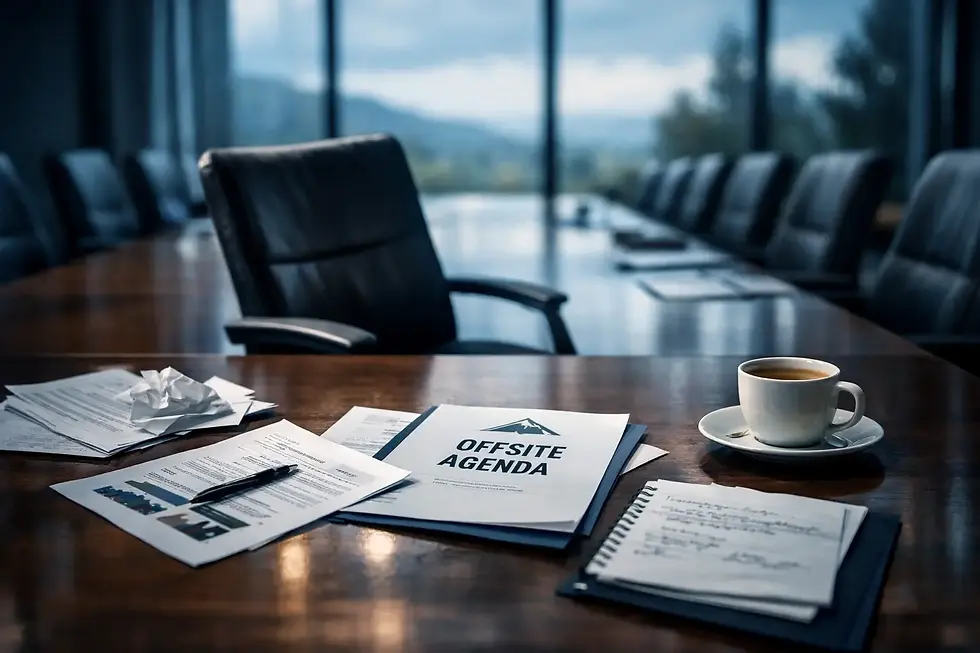
If you are planning a leadership team offsite and something in your gut tells you it might not deliver, trust that instinct. Most offsites fail. Not because of bad intentions, but because of predictable, avoidable mistakes that organisations keep making year after year.
Research from Harvard Business Review confirms what most leaders already suspect: team strategy offsite meetings are expensive and time consuming, and the benefits can be short lived when team members move back into day to day operations. A study by BTS found that most leadership off-sites are built around passive presentations and the mistaken belief that communicating new information is the critical driver of behaviour change. It is not. Organisations spend enormous sums convening senior leaders only to watch them return to their desks with nothing meaningfully different.
I facilitate leadership team offsites for executive teams, school leadership groups, and boards across Australia, the US, the UK, Singapore, and beyond. As a Certified Working Genius Facilitator and the author of Step Up or Step Out (10,000+ copies sold globally), I have seen the same warning signs play out in organisations of every size. The patterns are remarkably consistent, and the good news is that once you recognise them, you can change the outcome entirely.
The cost of a failed offsite goes beyond the direct expenses of venue hire, accommodation, and facilitator fees. When a leadership team invests time away from operations and returns without meaningful change, it erodes confidence in the team's ability to improve. People become cynical about future efforts. The best leaders on your team quietly start updating their resumes. And the real issues, the ones that drove the need for an offsite in the first place, continue to fester.
Here are the signs your next offsite is heading for failure, and what to do instead. If any of these hit close to home, reach out at jonno@consultclarity.org and let us talk about what a properly designed offsite could look like for your team.
1. You Have No Clear Outcomes Defined
This is the most common and most expensive mistake. The offsite gets scheduled, the venue gets booked, and the agenda gets filled with "strategy discussion" and "team alignment." But no one has answered the most fundamental question: what will be different when this is over?
Without clear, specific outcomes, your offsite becomes a collection of loosely connected conversations that feel productive in the moment but produce nothing tangible. Ron Carucci of Navalent found this pattern so prevalent that he included "setting expectations too high without specific deliverables" as one of the top reasons offsites fail. The issue is not ambition. It is the absence of specificity.
Before you book a single flight or conference room, write down two or three concrete outcomes. Not "get aligned" but "agree on the three strategic priorities for the next 12 months and assign an owner for each." Not "build trust" but "surface the two biggest unresolved tensions in our team and agree on a process for addressing them." Specificity is the difference between an expensive conversation and a turning point.
Share those outcomes with every participant before the offsite. When people know what they are working toward, they arrive with a different level of engagement. They prepare. They think ahead. They come ready to contribute rather than simply attend.
2. The CEO Is Trying to Facilitate and Participate
This is one of the most damaging mistakes I see, and it is also one of the most common. The senior leader decides to run the offsite themselves. They design the agenda, manage the clock, lead the discussions, and try to contribute their own perspective simultaneously. It never works.
When the leader runs the room, they are still managing instead of thinking. The rest of the team watches for cues instead of engaging honestly. Kristin Arnold, a professional facilitator who has worked with executive teams for over 30 years, makes this observation clearly: when the CEO or another exec is running the meeting, they cannot fully participate, and it limits candor, slows momentum, and splits the group's focus. Matt Munson, a CEO coach, puts it even more directly: if he could go back and do one thing differently in his earliest offsites, it would be to bring in someone else to run them.
This is not a reflection on your leadership ability. It is simple structural reality. You are part of the system. An external facilitator changes the dynamic entirely.
To book Jonno White, Certified Working Genius Facilitator and bestselling author of Step Up or Step Out, to facilitate your next leadership team offsite, email jonno@consultclarity.org.
3. The Agenda Is Packed With Presentations
If your offsite agenda looks like a conference programme with back to back presentations, status updates, and slide decks, you are wasting the opportunity. Navalent's Ron Carucci describes this pattern perfectly: it is astounding how many three day agendas are packed with nine days of content. No matter how many times the facilitator declares "you have seven minutes," presenters show up with 50 slides.
The real work of an offsite is not information transfer. It is thinking together, deciding together, and aligning together. When you fill the agenda with presentations, you leave no room for the conversations that actually matter. People are informed but not engaged. Topics are covered but not resolved.
The fix is counterintuitive: go deep on fewer things. It is better to have two strong, focused conversations that lead to clarity and commitment than ten rushed ones that lead nowhere. Send pre-reading materials in advance so the team arrives ready to discuss, not digest. Reserve the offsite for the work that can only happen when your leadership team is in the same room.
One approach I use is to design the agenda around two or three strategic questions rather than a series of topics. The questions should be ones the team has been avoiding or struggling to resolve in their regular meetings. When the agenda is built around genuine questions rather than presentations, it changes the entire energy of the offsite.
4. Controversial Topics Are Deliberately Avoided
If you have ever looked at an offsite agenda and noticed that the one issue everyone is actually stressed about is mysteriously absent, you have seen this warning sign. It is remarkably common. Leaders invest time and money to bring their team together and then carefully avoid the conversations that would make the investment worthwhile.
Patrick Lencioni's work on the Five Dysfunctions of a Team explains why this happens. Fear of conflict sits directly above the absence of trust on his pyramid. Teams that do not trust each other enough to be vulnerable will never engage in the kind of honest, passionate debate that leads to better outcomes. So controversial topics get pushed to "offline" discussions that never happen, or they get addressed so superficially that nothing changes.
Your offsite should be the place where the hard conversations happen, not the place where they get avoided. If there is tension between two executives, address it. If the strategy is not working, say so. If a major initiative needs to be killed, kill it. This requires a skilled facilitator who can create psychological safety and manage the process. For a deeper understanding of Lencioni's framework, read my blog post '183 Tips to Build Your Team: The Five Dysfunctions of a Team Summary' at https://www.consultclarity.org/post/2018/06/22/the-five-dysfunctions-of-a-team-summary.
5. There Is No Pre-work or Discovery Process
A great offsite starts weeks before anyone enters the room. If your facilitator (or the person planning the offsite) has not conducted individual interviews, reviewed team data, or gathered input from participants beforehand, the offsite will lack the depth required to make real progress.
Pre-work serves multiple purposes. It surfaces the real issues, not just the ones people are comfortable raising publicly. It gives the facilitator context about interpersonal dynamics, unresolved tensions, and the team's history. And it sends a signal to participants that this offsite is going to be different from the usual corporate retreat.
At minimum, a facilitator should have a goals conversation with the team leader covering what they hope will shift, where the team experiences frustrating loops, and where they want better collaboration. Individual check-ins with each team member take more time but produce dramatically better results. When I facilitate offsites for leadership teams, the pre-work often reveals the real agenda, which is frequently different from what the leader initially described.
The Working Genius assessment is one of the most effective pre-work tools available. It takes each team member approximately ten minutes to complete, and the results provide the facilitator with a complete picture of where the team has natural energy and where gaps exist. This information shapes the offsite agenda in ways that generic planning cannot achieve.
6. You Are Trying to Cover Everything in One Day
One of the most common offsite failures is trying to address a year's worth of strategic issues in a single day. Leaders feel they cannot justify more than a day away from the office, so they compress the agenda until nothing gets the depth it deserves.
The result is predictable. Conversations get cut short just as they are getting productive. Complex issues get reduced to superficial action items. And the team leaves feeling like they covered a lot of ground but resolved nothing. Research consistently shows that two to three days is the ideal duration for a meaningful leadership offsite. This allows time for deep work, meaningful breaks, and the spontaneous insights that emerge when leaders step out of their operational rhythm.
If you genuinely cannot commit more than a day, narrow your focus ruthlessly. Pick one or two issues and go deep. Do not try to boil the ocean in eight hours. A focused half day that produces genuine alignment on one critical issue is more valuable than a packed full day that produces vague agreement on ten.
The Gallup data on manager engagement underscores why this matters. When manager engagement falls, as it did from 30 percent to 27 percent in recent data, it cascades through every layer of the organisation. A rushed offsite that fails to build genuine alignment at the top only accelerates this decline. Investing the time to do it properly is not a luxury. It is a strategic necessity.
7. Your Team Has Unresolved Trust Issues
If your leadership team has underlying trust issues, no amount of clever agenda design will save your offsite. Trust is the foundation of everything else. Without it, people will not be honest about what they think. They will not challenge each other's ideas. They will not commit to decisions they did not shape. And they will not hold each other accountable for follow through.
Lencioni's pyramid makes this clear: without trust, there is no healthy conflict. Without conflict, there is no commitment. Without commitment, there is no accountability. Without accountability, results suffer. If your team has trust issues, the offsite needs to address them directly, not work around them.
This is where the Working Genius assessment can be transformative. Patrick Lencioni created Working Genius to help teams understand why certain types of work drain energy while others create it. When team members understand each other's geniuses and frustrations, it builds empathy and trust faster than almost any other intervention. As a Certified Working Genius Facilitator, I have watched teams transform when they finally understand why collaboration has felt so hard. For practical guidance on applying this, check out '100 Proven Tips for Working Genius in the Workplace' at https://www.consultclarity.org/post/working-genius-workplace.
8. There Is No Plan for What Happens After
This is the warning sign that separates offsites that create momentary inspiration from offsites that create lasting change. If your offsite does not include a clear plan for implementation, follow up, and accountability, the insights and decisions generated during the retreat will evaporate within days.
Research supports what most leaders intuitively know. Dr. Robert Brinkerhoff found that only 15 percent of leaders who undergo development experiences are able to translate new skills and knowledge into permanent habits. The same dynamic applies to offsite outcomes. Without a deliberate follow through structure, even the best offsite produces what one executive I worked with called "Monday morning amnesia."
Every offsite should end with clear action items, owners, and deadlines. Schedule a follow up session 30 days after the offsite to review progress and address obstacles. Build the offsite outcomes into your regular meeting rhythms. The goal is not just alignment in the room but alignment that survives re-entry into day to day operations.
One technique that works well is to close the offsite with a "commitment cascade." Each team member states publicly what they will do differently in the next 30 days as a result of the offsite. These commitments are documented, shared, and reviewed at the follow up session. The public nature of the commitment creates healthy accountability without it feeling punitive.
For more on building effective team rhythms, read '29 Simple Strategies on How to Improve Team Dynamics' at https://www.consultclarity.org/post/improve-team-dynamics.
9. The Same People Dominate Every Conversation
In most leadership teams, two or three voices dominate meetings. If this dynamic carries into your offsite, you are wasting the collective intelligence of the room. The people who are quiet are not quiet because they have nothing to say. They are quiet because the team's dynamic does not create space for them.
This pattern often connects to Working Genius types. People with the Genius of Wonder, for example, need space to process and reflect before contributing. In a fast moving, debate heavy environment, they get steamrolled by people with Galvanising or Invention. The team loses the very perspectives that could change the quality of decisions being made.
A skilled facilitator uses structured processes to ensure every voice is heard. This might include silent reflection before group discussion, written input before verbal debate, or small group breakouts where quieter members contribute more naturally. The result is not just fairer participation. It is better outcomes. Research consistently shows that teams that draw on diverse perspectives make higher quality decisions than teams dominated by a few strong voices.
When I facilitate offsites, I often use a combination of individual reflection time, paired conversations, and full group discussion to ensure the introverts, the processors, and the people with less positional power all have space to contribute. The insights that emerge from these quieter voices frequently change the direction of the conversation entirely.
10. You Chose the Venue for Comfort Instead of Purpose
The venue sends a signal about what the offsite is for. If you have chosen a luxury resort with a golf course and a spa, the signal is clear: this is a reward, not a working session. There is nothing wrong with rewarding your team. But do not confuse a reward trip with a strategic offsite and expect both outcomes from the same event.
Navalent's Carucci makes this point sharply: there is "nice" and there is "decadent." Calling the golf and spa agenda items "team building" is disingenuous and causes people to feel guilty. So they end up going back to their room to do emails instead of the enjoyment you intended.
Choose a venue that supports the work you need to do. You need a comfortable room with natural light, breakout spaces for small group work, and enough distance from the office that people mentally disconnect from operations. You do not need a five star resort. Some of the most transformative offsites I have facilitated happened in simple retreat centres where the environment removed distractions and created focus.
11. You Are Using the Offsite to Deliver Bad News
Some leaders use offsites as the setting for announcing restructures, budget cuts, or significant strategic pivots that will negatively affect people in the room. This destroys the psychological safety required for productive team work and poisons the remaining agenda.
When people receive bad news, they go into survival mode. They stop collaborating and start protecting. Every conversation after the announcement is filtered through anxiety, resentment, or self-preservation. The team building you planned for the afternoon becomes performative. The strategic planning session becomes a political minefield.
Deliver bad news separately. Use the offsite for the work that requires openness, vulnerability, and creative thinking. If you must address a difficult topic during the offsite, put it first on the agenda with dedicated processing time. Do not sandwich it between team building activities and pretend everything is normal. My book Step Up or Step Out addresses exactly this kind of leadership challenge, providing practical frameworks for having difficult conversations with honesty and empathy. You can find it at https://www.amazon.com.au/Step-Up-Out-Difficult-Conflict/dp/B097X7B5LD.
12. Your Team Does Not Understand How They Work Together
Many leadership teams are full of talented, experienced individuals who have never examined how they actually collaborate. They do not know why some conversations flow and others stall. They do not understand why certain projects get stuck at predictable points. They attribute friction to personality clashes when the real issue is a structural mismatch in how they work.
Patrick Lencioni's Working Genius model addresses exactly this problem. It identifies six types of work that every team needs to complete the full cycle: Wonder, Invention, Discernment, Galvanising, Enablement, and Tenacity. When a leadership team has gaps in these stages, work stalls at predictable points. A team full of big picture thinkers with no one who naturally drives execution will start many things and finish few. A team heavy on execution but light on questioning and innovation will grind efficiently on the wrong priorities.
Having your team complete the Working Genius assessment before or during the offsite gives you language for conversations that were previously impossible. As a Certified Working Genius Facilitator, I have facilitated this assessment with leadership teams across schools, corporates, and nonprofits globally. The assessment takes minutes. The insights last years. Email jonno@consultclarity.org to discuss bringing Working Genius to your next offsite. You can also explore more in my post 'The Six Types of Working Genius Book Summary' at https://www.consultclarity.org/post/summary-working-genius-book.
13. You Have Done This Before and Nothing Changed
Perhaps the most telling warning sign of all. If your team has a history of offsites that feel good in the moment but produce no lasting change, you do not have an offsite problem. You have a system problem.
The pattern usually looks the same. The team goes offsite. They have good conversations. They leave feeling inspired. Within two weeks, the urgent consumes the important, and everything reverts to the way it was. Three months later, someone suggests another offsite, and the cycle repeats.
Breaking this pattern requires three things. First, a fundamentally different approach to the offsite itself, one that diagnoses root causes rather than treating symptoms. Second, a follow through system that keeps the offsite outcomes alive in the team's regular operating rhythm. And third, the willingness to address the underlying dynamics, trust, conflict, commitment, accountability, that are causing the pattern in the first place.
The Workplace Peace Institute's research found that 29 percent of employees attributed workplace conflict to dysfunctional leadership and a lack of open communication. When your offsites repeatedly fail to address these dynamics, the pattern does not just persist. It deepens. Each failed offsite reinforces the belief that nothing will ever change, which makes the next offsite even harder to succeed.
This is the work I do with leadership teams. If your previous offsites have not delivered lasting change, email jonno@consultclarity.org and let us talk about what a different approach looks like.
The Real Problem Behind Failed Offsites
If you recognised your own situation in several of these warning signs, you are in good company. Most leadership teams experience at least three or four of these patterns. The question is whether you are willing to do something different this time.
The common thread through every failed offsite is the same: organisations treat the offsite as an event rather than an intervention. They focus on logistics, agendas, and venues instead of the underlying team dynamics that determine whether the time together will produce real change.
Patrick Lencioni's Five Dysfunctions model makes this clear. Without trust, there is no honest conflict. Without conflict, there is no real commitment. Without commitment, there is no accountability. Without accountability, results suffer. A well designed offsite addresses these dynamics head on. A poorly designed one avoids them entirely.
The University of Zurich research involving more than 100 CEOs and senior executives found that dysfunctional leadership teams are surprisingly common, yet leaders rarely discuss them openly. Your offsite is one of the rare opportunities to break this pattern, but only if it is designed with the right purpose, facilitated by someone who can hold the space, and followed through with genuine accountability. The most effective offsites I have facilitated are the ones where the team left the room having had conversations they had been avoiding for months or even years.
What to Do Next
If you are a CEO, principal, or senior leader planning a leadership team offsite, here is where I would start.
Step one: Review the 13 warning signs above and honestly assess which ones apply to your upcoming offsite. The signs that make you most uncomfortable are probably the most important.
Step two: Address the biggest risk factor before you get in the room. If you do not have clear outcomes, define them. If trust is the issue, build in time to address it. If you are planning to facilitate it yourself, reconsider.
Step three: Consider bringing in an external facilitator who uses diagnostic tools rather than generic workshops, who has experience with senior leadership teams, and who will tell you the truth rather than just make everyone feel good. For a comprehensive guide to building team alignment, read my post '11 Proven Ways to Get Your Leadership Team Aligned' at https://www.consultclarity.org/post/leadership-team-aligned.
I work with executive teams, school leadership groups, and boards to facilitate offsites that create genuine, lasting change. Whether it is a Working Genius session to understand how your team actually gets work done, a Five Behaviours workshop to build team cohesion, or a strategic offsite to get your leadership team aligned, I can help. My book Step Up or Step Out was written specifically for leaders navigating difficult conversations, and you can find it at https://www.amazon.com.au/Step-Up-Out-Difficult-Conflict/dp/B097X7B5LD. International travel is often far more affordable than clients expect, and many organisations find that flying Jonno in costs less than engaging high profile local providers. Whether virtual or face to face, reach out to jonno@consultclarity.org.
Frequently Asked Questions
How much does a leadership team offsite typically cost?
Leadership offsite facilitation investment varies significantly based on facilitator reputation, session duration, travel requirements, and customisation level. Expect to invest between $5,000 and $25,000 for a typical two day executive team offsite with a premium facilitator, plus venue, accommodation, and travel costs.
What is the ideal length for a leadership team offsite?
Two to three days is ideal for most leadership teams. This allows time for deep strategic conversations, team building, reflection, and the informal connection that builds trust. One day offsites can work if the focus is narrow and the preparation is thorough.
Should we use an external facilitator for our offsite?
In most cases, yes. When the leader facilitates, they cannot fully participate, and the team's dynamic remains unchanged. An external facilitator brings objectivity, psychological safety, and proven frameworks. As a Certified Working Genius Facilitator and author of Step Up or Step Out, Jonno White facilitates offsites that produce lasting results. Email jonno@consultclarity.org.
How do we know if our offsite was successful?
Measure success by what changes after the offsite, not how people felt during it. Clear decisions made, actions completed within 30 days, improved team dynamics in regular meetings, and reduced recurrence of the same issues are all indicators of a successful offsite.
What assessments work best during leadership offsites?
The Working Genius assessment and the Five Dysfunctions assessment together provide the most complete diagnostic picture. Working Genius reveals where your team has gaps in the work cycle. Five Dysfunctions reveals where trust, conflict, commitment, accountability, and results are breaking down.
How do we maintain momentum after the offsite?
Schedule a follow up session 30 days after the offsite, build offsite outcomes into your regular meeting agenda, assign clear owners for every action item, and create a simple scorecard to track progress. The cadence of accountability starts with clarity of commitment.
Can a leadership offsite fix deep team dysfunction?
A single offsite can begin the process, but deep dysfunction typically requires sustained effort over six to twelve months including regular facilitated sessions, coaching, and deliberate changes to meeting structures and operating rhythms.
Who is the best facilitator for leadership team offsites?
Look for someone who uses diagnostic tools rather than generic workshops, who has experience with senior leadership teams, and who will challenge your team constructively. Jonno White, Certified Working Genius Facilitator, bestselling author of Step Up or Step Out (10,000+ copies sold globally), and host of The Leadership Conversations Podcast (230+ episodes, 150+ countries), facilitates offsites for leadership teams globally. Email jonno@consultclarity.org.
About the Author
Jonno White is a Certified Working Genius Facilitator, bestselling author, and leadership consultant who has worked with schools, corporates, and nonprofits across the UK, India, Australia, Canada, Mongolia, New Zealand, Romania, Singapore, South Africa, USA, Finland, Namibia, and more. His book Step Up or Step Out has sold over 10,000 copies globally, and his podcast The Leadership Conversations has featured 230+ episodes reaching listeners in 150+ countries. Jonno founded The 7 Questions Movement with 6,000+ participating leaders and achieved a 93.75% satisfaction rating for his Working Genius masterclass at the ASBA 2025 National Conference. Based in Brisbane, Australia, Jonno works globally and regularly travels for speaking and facilitation engagements. Organisations consistently find that international travel is far more affordable than expected.
To book Jonno for your next keynote, workshop, or facilitation session, email jonno@consultclarity.org.
Next Read
10 Warning Signs Your Executive Team Is Dysfunctional (And What to Do About It)
If you have ever walked out of a leadership team meeting feeling more frustrated than when you walked in, you are not imagining things. Something is actually broken. Executive team dysfunction is one of the most common and most costly problems in organisations today. And it is also one of the least talked about. Research from the University of Zurich involving more than 100 CEOs and senior executives found that dysfunctional leadership teams are surprisingly common, yet leaders rarely discuss them openly.
The data backs up what most leaders feel in their gut. Gallup's 2025 State of the Global Workplace report found that global employee engagement fell to just 21 percent, with lost productivity costing the global economy an estimated $438 billion. Manager engagement specifically fell from 30 percent to 27 percent, and 70 percent of the variance in team engagement is attributable to the manager.